
This year marks two important milestones: 200 years of passenger rail travel and 200 years since Louis Braille introduced his life-changing writing system. Established in the early 19th century, both transformed lives in ways their pioneers could never have imagined.
The first passenger train journey in 1825 opened the world up—connecting people, places, and opportunities at a speed and scale never seen before. Just a year later, in 1824, a 15-year-old French student named Louis Braille gave the world another kind of freedom: a system of raised dots that allowed blind and visually impaired people to read, write, and claim their independence.
At first glance, trains and Braille might seem worlds apart. But they share a powerful truth: mobility and accessibility are at the heart of human dignity. Whether it’s the ability to travel or the ability to read, both represent freedom, autonomy, and the right to take part fully in society.
Inclusion on the Railways
Today, as we celebrate these bicentenaries, we are reminded that our transport system must work for everyone. Across the UK, you can now find Braille signage at stations, helping passengers identify key facilities such as toilets, lifts, help points, and platforms. In many stations, tactile paving on platform edges and audio announcements work alongside Braille to support safe and independent journeys. These changes may seem small, but for someone navigating a busy station without sight, they make all the difference.
For instance, TransPennine Express has installed tactile maps at Hull Paragon, Dewsbury, and Manchester Airport, branded as “Maps for All.” Developed in partnership with RNIB, these combine high-contrast visuals, tactile textures, raised print, and Braille lettering — ensuring they serve people across the full spectrum of vision ability. At Manchester Airport Station, you’ll even find Braille labels identifying key facilities like lifts, exits, and help points directly on the map itself.
And now, even smaller coastal stations are making changes. Northern Rail recently installed brand-new inclusive signage at St Annes-on-the-Sea, complete with Braille text — a small but significant detail. It was a joy to see the positive impact this had in real time.
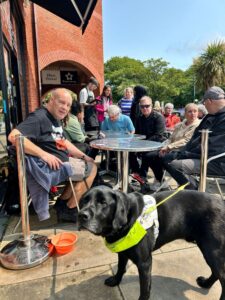
On Thursday 5 June, blind and partially sighted residents from across Lancashire came together for a special Railway 200 Try The Train event. This was hosted by Lancashire Sight Loss Council and Community Rail Lancashire — and supported by Thomas Pocklington Trust — the day was designed by and for blind and partially sighted people, marking 200 years since the birth of the modern railway.
With the support of guides, participants travelled by train from Preston to Lytham St Annes, navigating stations, boarding carriages, exploring layouts, and enjoying the sea air along the promenade — followed, of course, by coffee and cake.
(Below you can see a member of the group reading the new sign)
Why These Milestones Matter Together
Just as the first train opened the world beyond a person’s immediate village, Braille opened the world of ideas, knowledge, and communication. One connected physical journeys across landscapes; the other connected minds across distance.
As we look forward to the next 200 years, we must keep pushing so that rail is inclusive at it’s core and not just afterthought. The tactile maps are a brilliant example of how design can close gaps, not widen them.
When we place accessibility at the heart of progress, we pay tribute to both George Stephenson’s vision and Louis Braille’s legacy.
Here’s to the next 200 years—where rail is not just about moving people but about connecting lives equally and freely.